

of

8. Preparation for the freediving test

55-copia-1

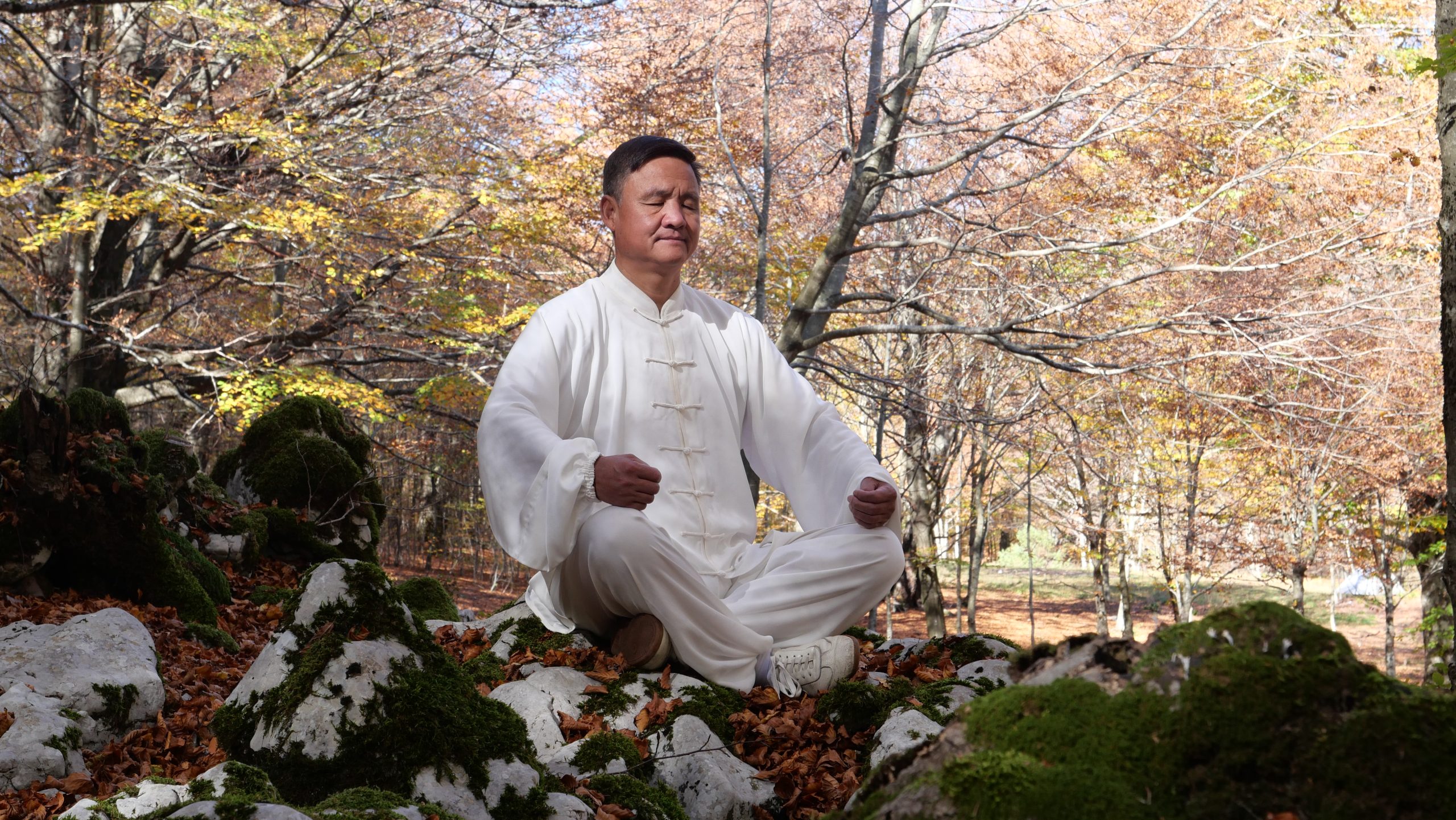
Before any apnea, whether it is static, dynamic or deep, it is a good idea to take a time where you isolate yourself and relax, breathing in stillness and awareness, detaching your mind as if in a kind of meditation, to clear it of anxieties and stress.

Statics:

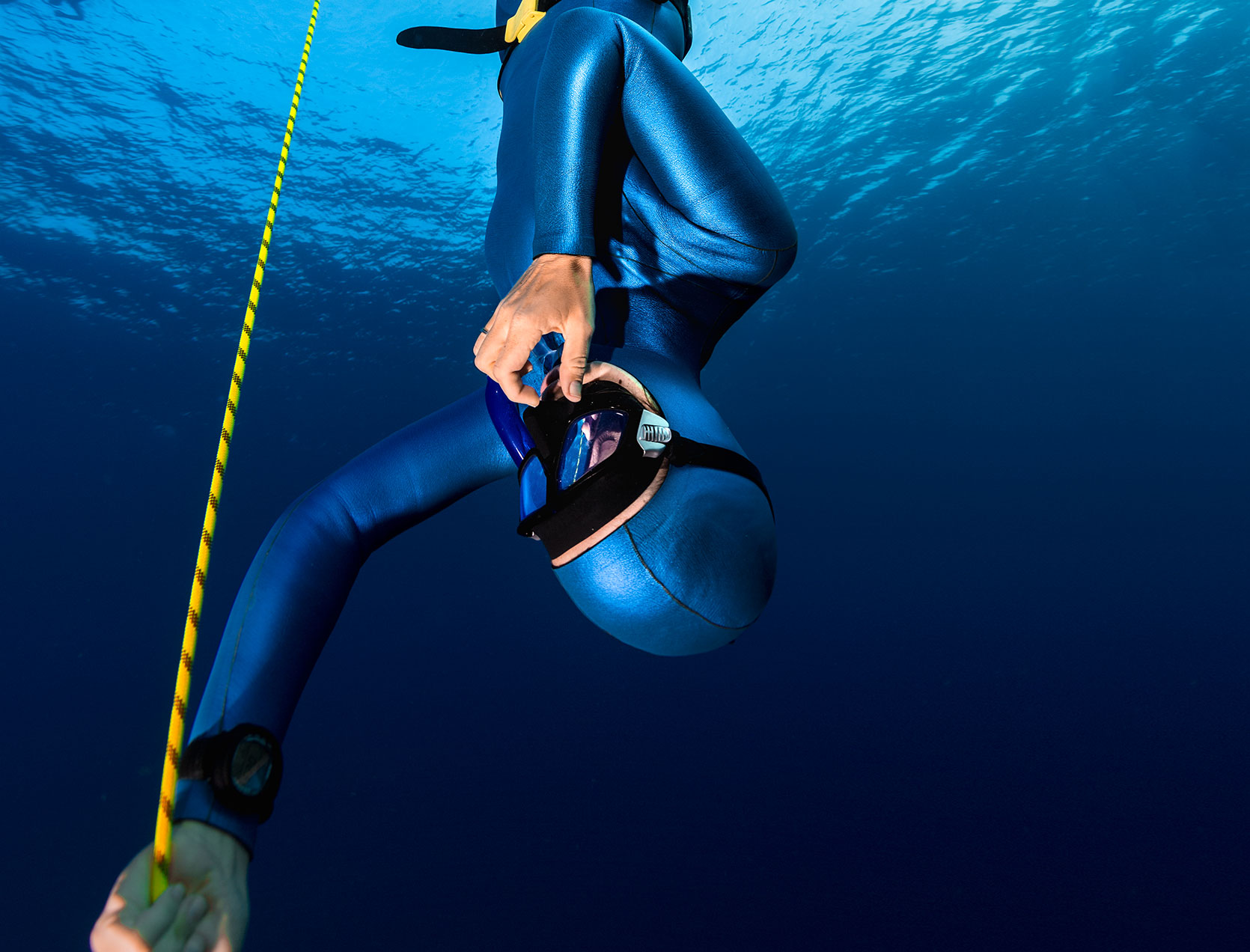
the athlete enters the water and is generally in an area of the pool where you have footing and near the edge. Put on your mask or goggles and a nose plug and breathe gently through your mouth. When he feels ready, he takes his last breath-which is generally more consistent than those taken during his preparation (an expert uses carping or glosseous pharyngeal breathing)-and puts his head in the water, lying flat on his stomach on the water’s surface.
He will adopt all the techniques learned up to that point to divert his attention from the passage of time. Contractions arrive, which will gradually become more important, and he will continue on the mental pathwith which he has been training. When he decides to pull his head up, he will take nice deep breaths and then give an okay, to show self-awareness and good health.

Dynamics:

The athlete is in the water waiting for the start. Breathe gently. When the time comes he takes in air, and generally an experienced freediver will store a huge amount of air, using the carp method or pharyngeal glossy breathing.
He begins the performance during which he will swim using the rhythm and relaxation routes set during training. Here, too, there will be many moments when one is tempted to put one’s head out of the water, partly because, compared to adeep apnea, in which the freediver is not close to the surface, in the static and in the dynamic, for every second that passes and for every meter that is covered, it is always he himself who decides whether or not to stop the test: it is, from time to time the diver who chooses, second by second or meter by meter, to continue or to stop, the air is at hand!

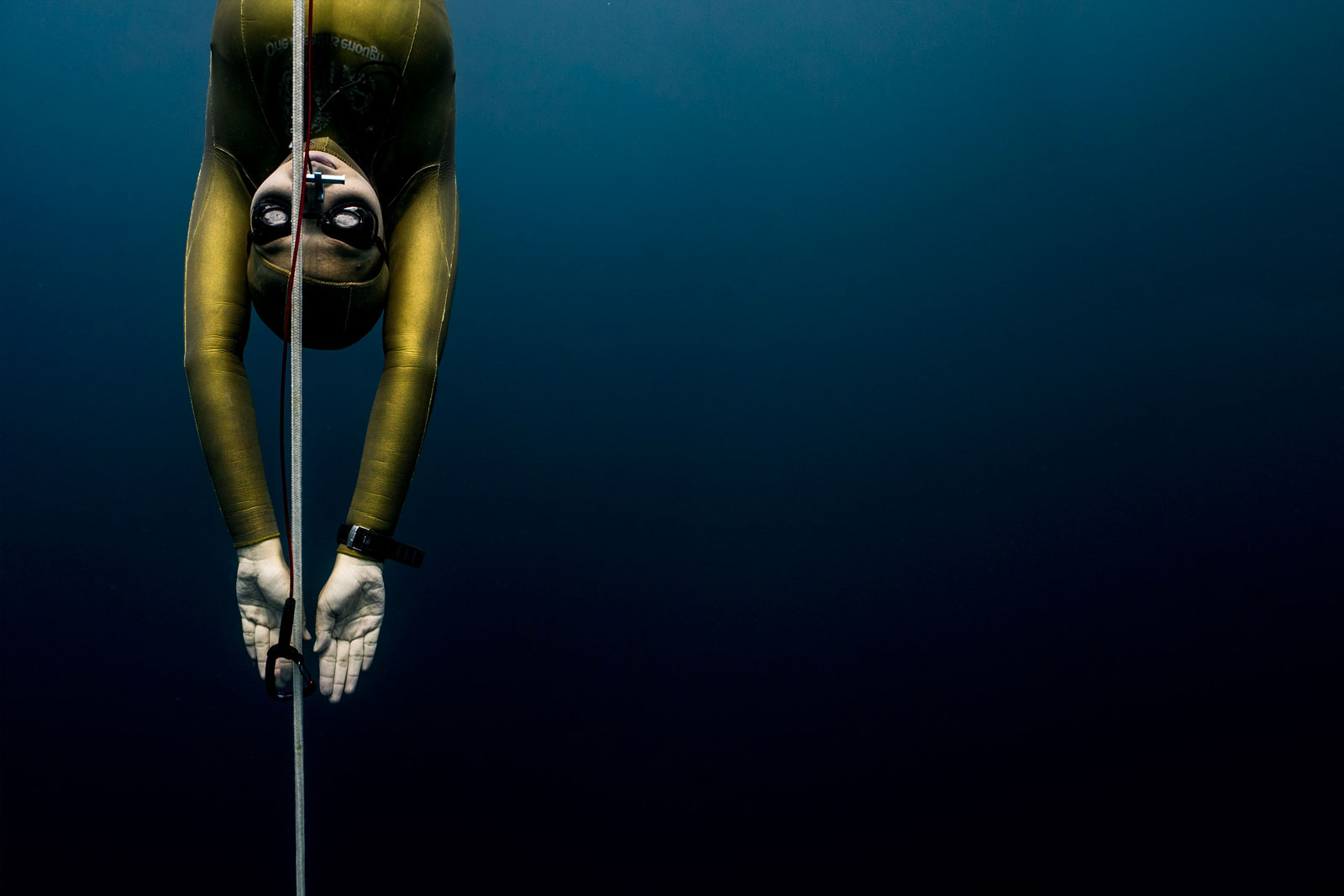
In the depths the matter is different, since we have to reach the surface, so the mental struggle we engage in is not “to put or not to put” our head above water, but not to let the discouragement of not making it, of still being far away and therefore wanting to speed up to get back to breathing as soon as possible.

The finning

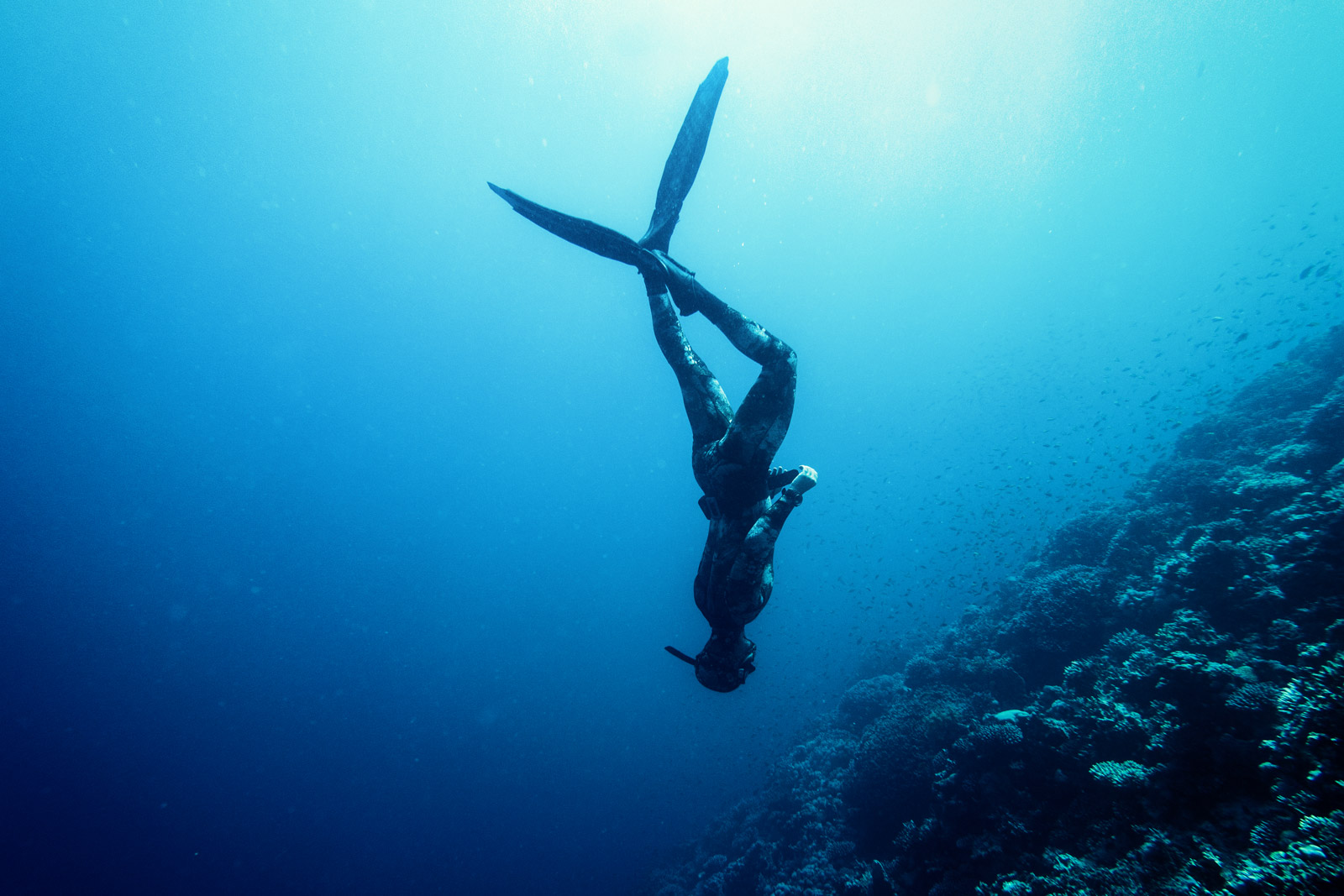
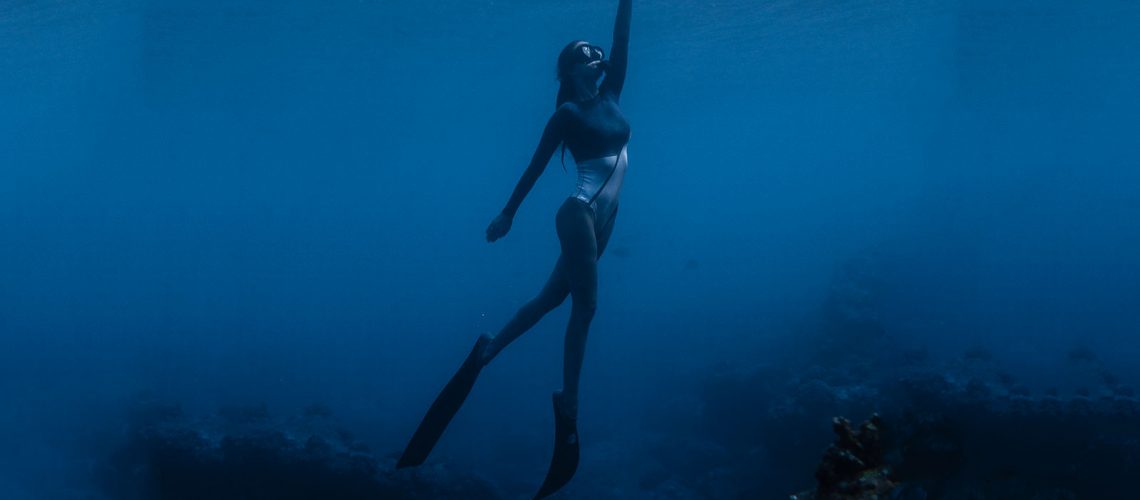
There is no such thing as a one-size-fits-all finning: it varies depending on the height of the subjects, their build, muscle tone, the type of fins (or monofins) being used and the respective hardness and discipline with which one is confronted. With respect to the latter, in fact, while in dynamic apnea the finning is or should be more or less constant throughout the journey made by the athlete, when going deep, the action of finning varies greatly whether one is at the beginning of the dive, in the middle or at the end. Immediately after the initial capsize, in fact, the deep-sea diver adopts a more energetic finning to overcomepositive buoyancy and buoyancy.
Once he has passed the first few meters, he slows down his pace more and more, until he stops finning altogether, when he has reached the point where he will have negative buoyancy: here he will take advantage of the natural sinking phenomenon, simply letting himself fall to the bottom.

Once he reaches his target, however, to begin the ascent, he will again have to fin hard in the first few meters to implement what is called a detachment from the bottom and counteract the strong negative buoyancy dragging him down. As it climbs it will find its ideal pace, considering the ratio of energy consumption to meters traveled. When it approaches the surface and senses that the wetsuit, which had been crushed due to pressure, is returning to its original thickness and that it has entered or is about to enter a positive buoyancy zone, it can then slow down and happily reach the air without further effort. The reduction in the frequency and strength of the finning is, at this point, invaluable precisely to save the last reserves of oxygen and return to the surface unharmed.

To recap:

a good finning is one with which there is minimal energy consumption related to a good number of meters traveled. The right movement, moreover, should start from the hip and go all the way to the tips of the toes, thus giving momentum with the whole leg and directing the work of the paddles well and making them move in their entirety. You should not bend your knees and do that wasteful “pedaling” work, nor should you tend with your feet inward or outward.

by Mariafelicia Carraturo
www.feliciacarraturo.it

FEATURED SPECIALISTS

  • Profile picture of Dott.ssa Maria Grazia Caruana
    active 5 years, 6 months ago

    Aesthetic Doctors, Basic Doctors

    • Viale Prassilla 41 - Roma
    phone
  • Profile picture of Dott.ssa Anna Puccio
    active 5 years, 6 months ago

    Gynecologists, Basic Doctors

    • Via Vincenzo Ponsati 69 - Volvera
    phone
  • Profile picture of Dott. Gianlorenzo Casani
    active 5 years, 6 months ago

    Geriatrics, Certifying Doctor, Basic Doctors

    • Via Costantino Baroni 71/73 - Milano
    phone
  • Profile picture of Dr. Giovanni Arrichiello
    active 5 years, 6 months ago

    Gynecologists, Basic Doctors

    • Corso Regina Margherita 260 - Torino
    phone
  • Profile picture of Dott. Franco Cicerchia
    active 5 years, 6 months ago

    Ophthalmologists, Acupuncturists, Basic Doctors

    • Via Alcide de Gasperi 39 - Palestrina
    phone

RELATED ARTICLES

Water sports

We have now reached the height of summer. Temperatures are beginning to rise relentlessly and the heat is beginning to take its toll, especially on those who practice sports. Running,

Why choose a mountain vacation

Every year during the summertime millions of people flock to major beach resorts to enjoy a well-deserved vacation under an obrellone or taking a dip in the sea. This is

The support of the foot during running

Running is one of the most popular physical activities for several reasons. Primarily because it does not require any kind of special or even expensive equipment, the only thing you

1. Equipment

Freediving is an environmental sport that is practiced in the water and, for this reason, requires specific equipment that gives us comfort and safety.

RELATED PATHOLOGIES

Bronchiectasis

The term “bronchiectasis” refers to a respiratory condition affecting the bronchi that is characterized by the presence of dilatations and degeneration of bronchial tissue, associated with the presence of “mucus

Pulmonary emphysema

Emphysema is a respiratory condition that is part of the clinical picture characteristic of chronic obstructive pulmonary disease (COPD) and is characterized by a progressive destruction of the lung septa

Alzheimer’s disease

Alzheimer’s disease is the most common and severe degenerative disease of the brain, characterized by a progressive decline in cognitive functions (in particular, memory and language) associated with aging. It

Insomnia

Insomnia is an extremely common sleep disorder that can affect people of all ages for different reasons and come in various forms and variations, all of which have in common

Cerebral aneurysm

A cerebral aneurysm is a vascular malformation that presents as a small spherical protrusion or bulge along the wall of an artery present in the brain. Its presence is risky

Ischemic stroke

According to the official definition of the World Health Organization (WHO), stroke corresponds to a “sudden onset of signs and/or symptoms referable to local and/or global deficits in brain function,

Spinal canal stenosis

Spinal canal stenosis consists of the narrowing of a section of the canal present along the entire spine (formed by the aligned succession of small holes in the center of

Migraine

Migraine is a primary headache that is manifested by recurrent attacks of moderate to severe headaches, varying in duration from 4 to 72 hours, interspersed with symptom-free periods. Sometimes migraine

Syncope

The term syncope refers to an episode of fainting, that is, a sudden loss of senses, which can affect people of any age and can be induced by a variety

Respiratory failure

A condition of “respiratory failure” is present when the respiratory system is unable to ensure efficient gas exchanges through the lungs, preventing the maintenance of an adequate balance between oxygen

FEATURED SPECIALISTS

  • Profile picture of Dott.ssa Erminia Maria Ferrari
    active 5 years, 6 months ago

    Homeopathic Medicine, Basic Doctors, Pediatricians

    • Via San Carlo 3 - Castel Rozzone
    phone
  • Profile picture of Dott.ssa Izabella Sylwia Bartosiewicz
    active 5 years, 6 months ago

    Basic Doctors, Rheumatologists

    phone
  • Profile picture of Dott.ssa Carmela Tizziani
    active 5 years, 6 months ago

    Coroner, Certifying Doctor, Basic Doctors

    • Via Gaetano Bruno 25 - Napoli
    phone
  • Profile picture of Dott. Massimo Carotenuto
    active 5 years, 6 months ago

    General Surgeons, Basic Doctors

    • Via Lepanto 95 - Pompei
    phone
  • Profile picture of Dr. Giuseppe Lepore
    active 5 years, 6 months ago

    Dermatologists, Basic Doctors, General Surgeons

    • 19 Via Manzoni Alessandro - Garbagnate Milanese
    phone

prenota il tuo viedeoconsulto in convenzione

Completa il form e sarai contatto dal personale medico specializzato

your advertising
exclusively ON
MY SPECIAL DOCTOR

complete the form and you will be contacted by one of our managers