



of

Discovering Mindfulness: a practice for feeling good about yourself

o-MORNING-MINDFULNESS-PRACTICE-facebook

The concept of Mindfulness is aimed at identifying a set of practices useful for rediscovering and increasing awareness of one’s own experience and feelings, both physical and mental, with the aim of reducing the psycho-physical, relational and emotional stress of our existence. The idea behind the Mindfulness methodology is to approach life, one’s feelings, perceptions and thoughts without any judgment, but with a calm and gentle attitude.

The MBSR ( Mindfulness Based Stress Reduction) method originated in the late 1970s at the University of Massachusetts from the mind and experience of Jon Kabat-Zinn. The training practices, both physical and mental, proposed by Kabat-Zinn were effective right away against chronic pain, anxiety, depression, psychosomatic illnesses, and even eating disorders. The MBSR program involves an 8-week-long training cycle that encompasses various activities in order to increase and achieve full awareness of one’s body and mind for one’s mental and physical well-being.

The various activities are highly participatory, supportive and are structured according to the guidance of a conductor, some of them carried out in groups with specific communication exercises. The “Mindfulness Tools“, the name by which we denote the residential training days that enable participants to approach the practice of the MBSR method, are many and varied in nature. Very important are those on meditation, aimed initially at attention on one’s breath to the sensations coming from every part of our body and mind, but also those on Yoga, the exercises on walking and even those aimed at awareness in eating. We will, over the course of the various articles on our portal, go through them in detail one by one.

Meditation exercises

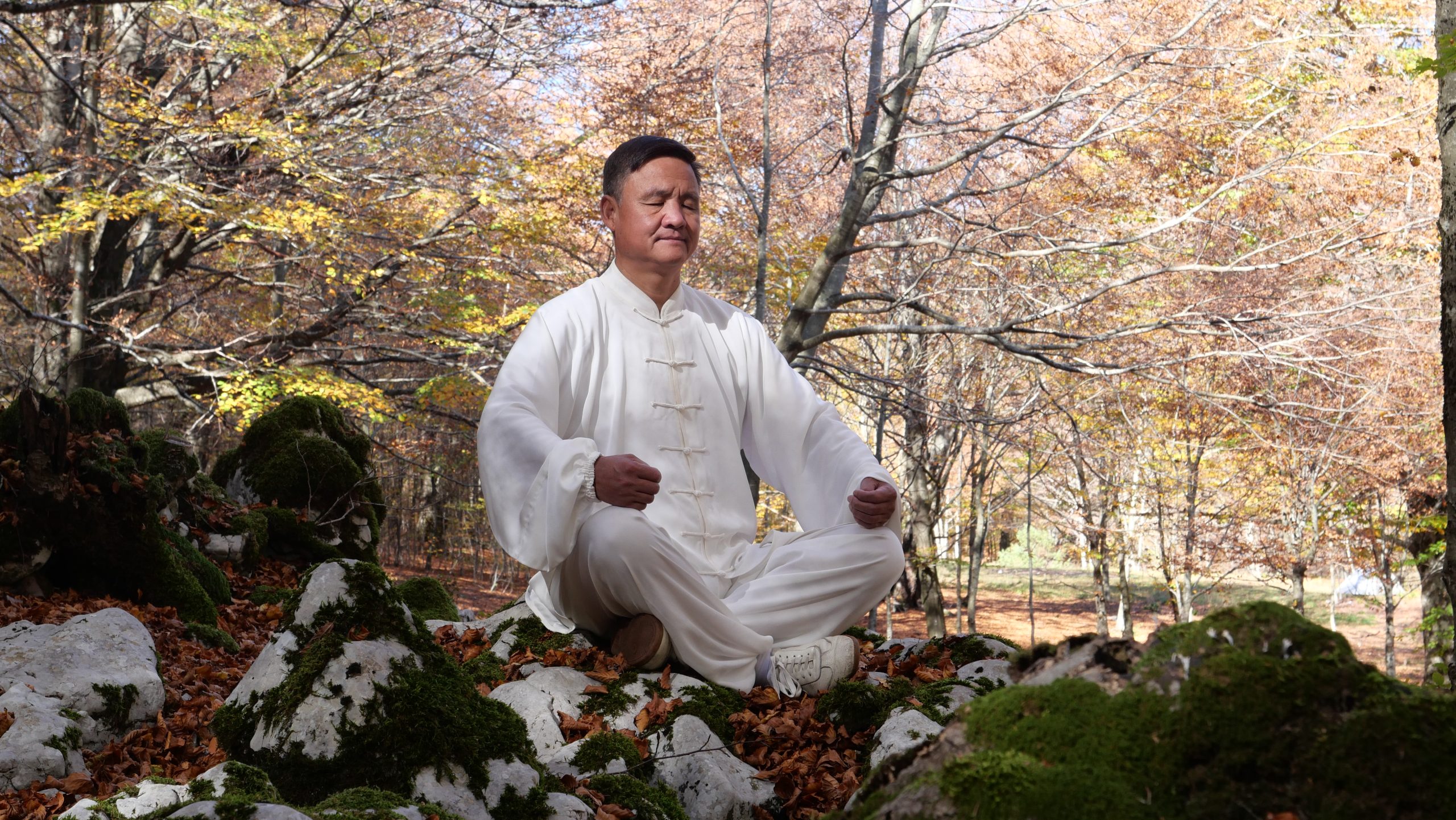
The meditation exercise should be done for about 20 to 30 minutes for at least once or twice a day. You need to sit in a comfortable position and remain as still as possible with your back erect and head straight, and focus on these points:

  1. Be aware of the inhalation and exhalation
  2. Be aware of each sensation in different parts of the body
  3. Be aware of the body as a whole
  4. Listen to the silence and sounds
  5. Observe thoughts and emotions as they move in and out of your awareness, but do not allow yourself to be distracted by their contents
  6. When you notice that your mint is wandering among various thoughts and feelings, gently bring it back to being attentive to the present moment

Underlying this phase of meditation must be a nonjudgmental attitude toward life, meaning that the mind should not be allowed to wander on its own toward the things it likes, avoiding those that cause it pain. Meditation is an effortless awareness of the totality of life, of each individual aspect; it represents concentration on the present you are living. By performing this exercise consistently and attentively at least once a day, we are able to strengthen our sense of balance, being able to counter emotional upsets and positive/negative feelings in our lives, and to approach our daily activities and relationships with others in a relaxed and balanced way.

Mindful eating

Another area in which the practice of Mindfulness is practiced concerns, as already anticipated, the field of nutrition. This is one of the areas in which the Mindfulness approach takes on fundamental importance for the mental and physical well-being of the individual. The Mindfulness approach applied to the field of nutrition involves eating more mindfully and somewhat more slowly than usual. As an experiment, to begin with, you can try eating at least one meal a week in absolute silence, focusing essentially on the act of pure and simple eating. Very important also would be to eat with the TV off and without paying attention to smartphones and other sources of distraction (radio, books…). These behaviors will help make you more sensitive to the way you eat and, more importantly, make you put your attention on what you actually choose to eat. Of course, you need to pay attention not only to what you decide to eat but also to the people who will take part in the meal with you, and to your surroundings.

With this in mind, it appears to be of great help to ask ourselves questions before consuming the meal, to try to understand what motivates us to eat at that precise moment. For example:

  • Am I eating to nourish my body and keep it properly healthy?
  • Am I eating to satisfy the desire for pleasurable sensations?
  • Am I aware of where the food I am eating comes from?
  • Is it a natural food or is it treated with preservatives and other substances novice to the body?

FEATURED SPECIALISTS

  • Profile picture of Dr. Fabio Fabi
    active 5 years, 6 months ago

    Sports Doctors, Internist, Basic Doctors

    • Via Sarsina 147 - Roma
    phone
  • Profile picture of Dr. Sergio Ettore Salteri
    active 5 years, 6 months ago

    Basic Doctors, Chiropractors, Posturologists

    • Via Vial di Romans 8 - Cordenons
    phone
  • Profile picture of Dott. Massimo Carotenuto
    active 5 years, 6 months ago

    General Surgeons, Basic Doctors

    • Via Lepanto 95 - Pompei
    phone
  • Profile picture of Dr. Giandomenico Mascheroni
    active 5 years, 6 months ago

    Endocrinologists, Basic Doctors, Certifying Doctor

    • Via Petrarca 53 - Carnago
    phone
  • Profile picture of Dott.ssa Erminia Maria Ferrari
    active 5 years, 6 months ago

    Homeopathic Medicine, Basic Doctors, Pediatricians

    • Via San Carlo 3 - Castel Rozzone
    phone

RELATED ARTICLES

Epileptic seizure: what to do?

The seizures are self-limiting and very often do not allow a rapid intervention. It is necessary, therefore, to keep some pointers in mind: Preventing lessons that the patient might unintentionally

Kaposi’s disease: what is it?

Kaposi’s sarcoma is a rare type of cancer caused by a virus, called HHV8, belonging to the herpes virus family. It can affect both the skin and internal organs. Approximately

The revolution of the adolescent self

As we know, adolescence is an extremely vibrant and fruitful phase of human development in which the line between normality and pathology becomes difficult to draw.

The toxic shock syndrome

Toxic shock syndrome is a particularly risky type of shock caused by toxins produced by bacteria (staphylococcus or streptococcus).

Sun, sea, acne

In summer, acne fears two elements: strong heat and humidity. Skin care must take into account some basic elements to avoid annoying reactions of pimples during summertime.

RELATED PATHOLOGIES

Post-traumatic stress disorder

Post-traumatic stress disorder (PTSD) is a psychiatric disorder that can occur at any age in people who have experienced or witnessed a traumatic event that has made them feel life-threatening

Anxiety

Anxiety or, more precisely, “generalized anxiety disorder,” as stated in the “Statistical Diagnostic Manual of Mental Disorders-DSM 5.” It is a psychiatric illness characterized by: intense and persistent worry and

Uncontrolled eating disorder

Uncontrolled eating disorder is an eating behavior disorder that is characterized by an inability to control food intake, resulting in the more or less frequent repetition of binges similar to

Headache

Headache, the so-called “headache,” is probably the most common form of pain. It is chronic or recurrent pain affecting various structures of the head, such as arterial and venous vessels,

Anorgasmia

Anorgasmia is the syndrome by which we refer to the difficulty in having orgasms even after normal sexual stimulation. The intensity and frequency of orgasms in women are variables that

Meniere’s Syndrome

Meniere’s syndrome is a balance disorder characterized by recurrent and unpredictable “attacks” involving the onset of intense dizziness, associated with reduced hearing, whistling and buzzing. Each attack is heralded by

Major depression

Major depression (or “major depressive disorder,” as stated in the “Statistical Diagnostic Manual of Mental Disorders – DSM 5”), is a mood disorder that is characterized by the presence of

Peyronie’s or curved penis disease

Peyronie ‘s disease is a condition resulting from an abnormality of the penis due to fibrous scar tissue that appears on the penis changing its shape during erection, which becomes

Epilepsy

Epilepsy is a chronic neurological disorder of the central nervous system, characterized by recurrent acute attacks (seizures), unpredictable in frequency, intensity and duration, interspersed with periods of well-being in which

Hemorrhagic stroke

According to the official definition of the World Health Organization (WHO), stroke corresponds to a “sudden onset of signs and/or symptoms referable to local and/or global deficits in brain function,

FEATURED SPECIALISTS

  • Profile picture of Dr. Monica Gamba
    active 5 years, 6 months ago

    Aesthetic Doctors, Plastic Surgeons, Basic Doctors

    • Viale Radich 21/N - Grugliasco
    phone
  • Profile picture of Dott.ssa Floriana Di Martino
    active 5 years, 6 months ago

    Aesthetic Doctors, Basic Doctors

    • Piazza della Rinascita 13 - Pescara
    phone
  • Profile picture of Dott.ssa OLGA PETROVSKAIA
    active 5 years, 6 months ago

    Pain therapists, Basic Doctors, Therapist

    • Via Giulio Romano 3 - Valle Martella
    phone
  • Profile picture of Dott.ssa Anna Puccio
    active 5 years, 6 months ago

    Gynecologists, Basic Doctors

    • Via Vincenzo Ponsati 69 - Volvera
    phone
  • Profile picture of Dott. Sandro Morganti
    active 5 years, 6 months ago

    Orthopedists, Basic Doctors, Osteopaths

    • Via Foligno 6 - Roma
    phone

prenota il tuo viedeoconsulto in convenzione

Completa il form e sarai contatto dal personale medico specializzato

your advertising
exclusively ON
MY SPECIAL DOCTOR

complete the form and you will be contacted by one of our managers