

of

7. Apnea specialty.

Lezione-7

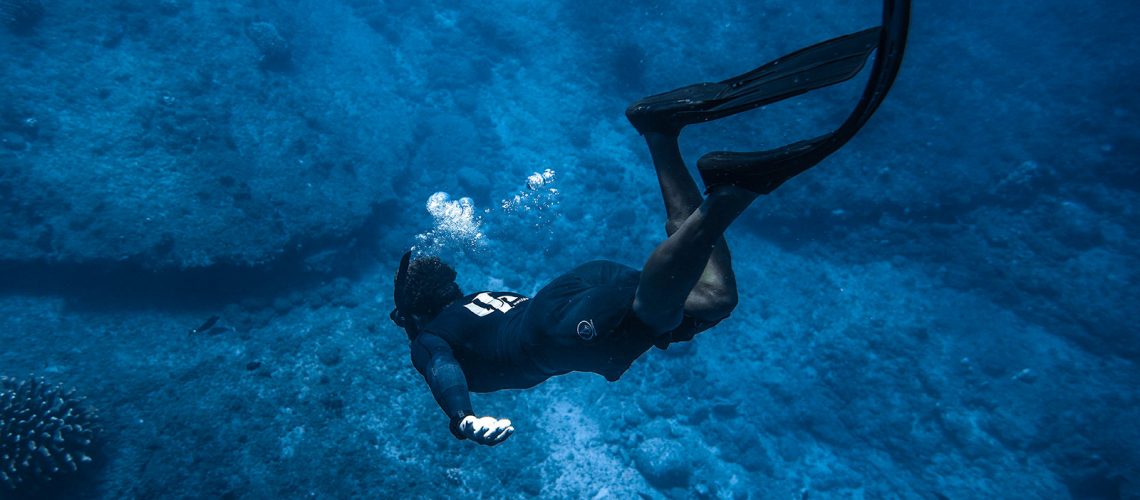
In addition to static apnea, which we discussed in Lesson #7, we have DYNAMIC apnea and DEEP apnea.

Dynamic Apnea

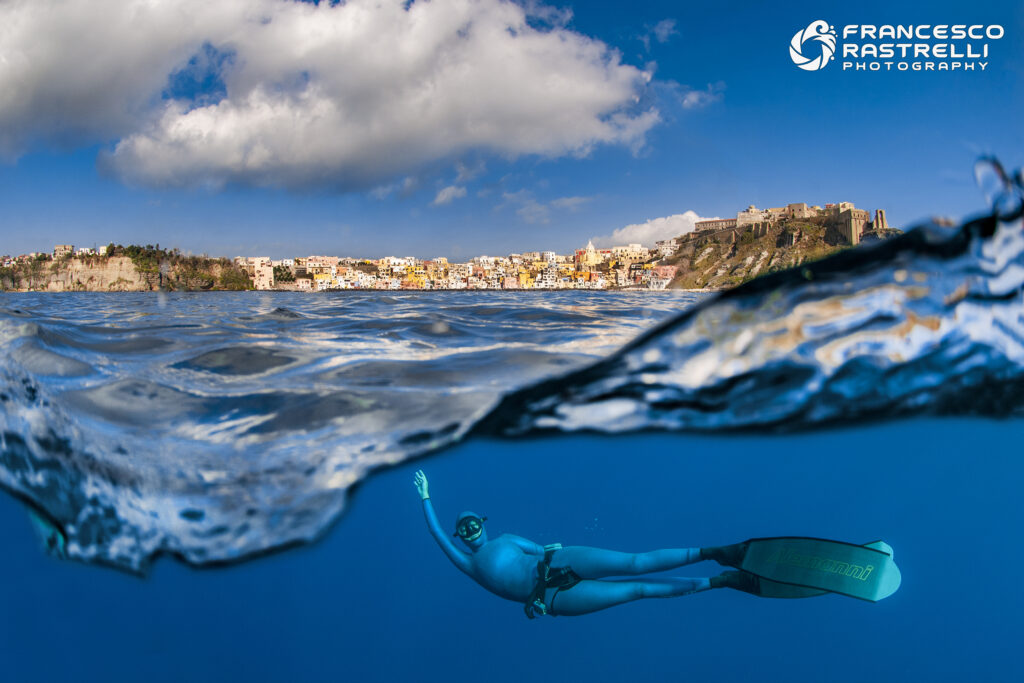
The dynamic one is practiced in the pool and is divided into apnea with or without gear: the athlete tries to cover as many meters as possible while submerged and swimming either underwater breaststroke or using the two fins or monofin. Compared to static, in which one must “only” hold his or her breath, here the freediver must calibrate the right weighting and finning.
We talk about the right weight since even in the pool we wear a wetsuit, usually a very thin one-to counteract the cold water, which is not conducive to a relaxed condition-which, however, will inevitably tend to make us float.
The rhythm and amplitude, moreover, of finning are key elements of a pool performance.
Having calibrated these two parameters, the athlete can devote himself to his mental path and, compared to static, here there is objectively a path, made up of meters that follow one another, of reaching an edge whose approach is marked by the “T” present on the bottom of the pool, the turn and finding, after it, the right trim and the right finning to go through another pool.
The hardest phase is the onset of air hunger and the freediver’s willingness, instead, to want to travel more meters.
This is when the importance of the mental preparation: instinct would tell us to increase our speed, but there is no greater mistake than that, as intensifying our finning would mean increasing our oxygen consumption, which is already residual at the end of the test and this can lead to the occurrence of syncope or black out. These are generally more common in limited basins (pool) as the athlete feels more confident and tends to “push” their performance more. It follows that even and especially in the swimming pool it is necessary to adopt the so-called pair system : never alone!

https://youtu.be/BezvuIMQTNg&feature=youtu.be

Control, the ability to relax and understanding that in the delicate phase of air hunger, when the annoying diaphragmatic contractionscome, it is necessary to slow down instead of speeding up, are very important.
It is helpful to adopt one’s own mental path to deal with such a test and to havepositive self talkthat incites us to move forward and distracts us from negative thoughts. Dynamic apnea always ends with an exit protocol, which is used to test the athlete’s lucidity and condition of presence to himself or herself, which completes his or her underwater journey correctly.

Deep Apnea

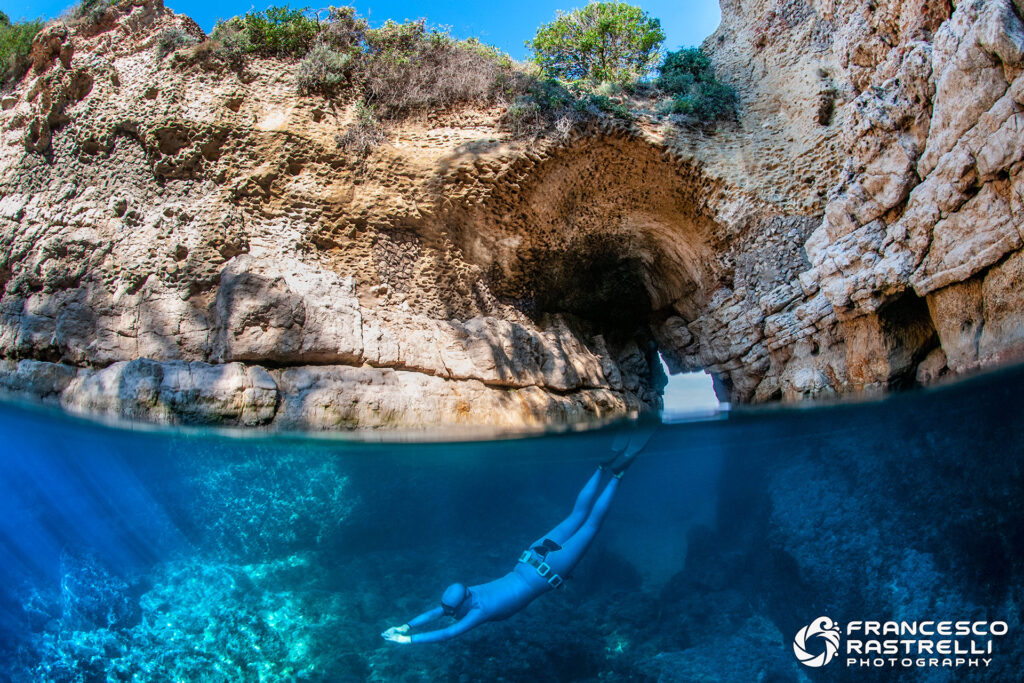
A deep dive is composed, broadly speaking, of the descent phase and the ascent phase. In the sea, the elements and actions that the freediver must face and perform are many more than in dynamic or static freediving. We are confronted, first of all, with the meteomarine conditions: wave height, surface and deep current, visibility in the water, and cold weather. The freediver, moreover, will have to deal with the resulting pressure and crushing as he or she descends into the abyss, and this involves mastering not only relaxation techniques, as in static and dynamic, but also compensation techniques. Indeed, the hunger for air is replaced here by the difficulty of compensating ears and/or a certain restlessness that the abyss can cause in some individuals, which causes them to stop their descent, turn around and return to the surface. In a large number of cases, unless we are talking about professional athletes, compensatory difficulties arise precisely from a less than perfect state of ease in the water and relaxation in facing the deep blue. It is difficult for a diver to feel, on descent, that he or she is running out of oxygen: compensatory and relaxation difficulties on crushing due to pressure will come first.

The sensation of running out of air, on the other hand, the athlete will feel it near the surface, where his or her lungs are returning to their original volume, and that is the moment when the urge to want to breathe again is felt most strongly. Here, too, instinct would lead us to increase the speed of our finning to get our head out of the water as quickly as possible, but, again, as with dynamic apnea, there can be no bigger mistake: we are at the end of a deep dive, during which we have had quite a bit of energy expended, we are shaken by diaphragmatic contractions, which are the manifestation of the fact that we are running out of oxygen, we have struggled to descend after the flip and throughout the ascent, now, in order to complete our dive we need to relax and slow down.

It is intuitive how, again, having good self-control, positive self-talk that puts the focus on the path already taken, versus the path yet to be taken, not raising our heads to see “how much further,” determine the success of our apnea.
Never alone, again, is a must.

As with dynamics, even after a bottom dive, it is a good idea to have an exit protocol that indicates the athlete’s good health and presence to himself or herself.

by Mariafelicia Carraturo
www.feliciacarraturo.it

FEATURED SPECIALISTS

  • Profile picture of Dott. Massimo Carotenuto
    active 5 years, 6 months ago

    General Surgeons, Basic Doctors

    • Via Lepanto 95 - Pompei
    phone
  • Profile picture of Dott.ssa Anna Puccio
    active 5 years, 6 months ago

    Gynecologists, Basic Doctors

    • Via Vincenzo Ponsati 69 - Volvera
    phone
  • Profile picture of Dott.ssa Emanuela Costantino
    active 5 years, 6 months ago

    Neurologists

    • Via Gallinara 2/B - Cagliari
    phone
  • Profile picture of Dott. Gianlorenzo Casani
    active 5 years, 6 months ago

    Geriatrics, Certifying Doctor, Basic Doctors

    • Via Costantino Baroni 71/73 - Milano
    phone
  • Profile picture of Dr. Vittorio Margutti
    active 5 years, 6 months ago

    Orthopedists, Basic Doctors

    • Via Marco Simone Poli 1 - Guidonia Montecelio
    phone

RELATED ARTICLES

10. Plants in space.

The International Space Station (ISS) has operated continuously for more than twenty years in Earth orbit, hosting teams of astronauts and scientists on research missions lasting up to several months; among the purposes of this research is the development of technologies that can keep a crew alive on missions beyond Earth orbit.

2. The water environment

Buoyancy thrust and pressure. A body, immersed in a liquid, receives a bottom-up thrust equal to the weight of the displaced liquid volume.

7. Apnea specialty.

In addition to static apnea, which we discussed in Lesson #7, we have DYNAMIC apnea and DEEP apnea.

How, how much and what to drink indoors

“The cold season is here. Fewer hours of daylight, frigid temperatures, frequent rain and a whole host of inclement weather cause many of you endurance enthusiasts to take refuge within

How important is sports for children

The vacations are almost over, September is approaching, and all the children are about to return to their school desks. Homework returns, friends are reunited, and the usual daily routne

The clothing to avoid in case of Cellulite

When we talk about Cellulite prevention, in addition to dwelling on eating habits, exercise and lifestyle, we must also dwell on one of the aspects of daily life: the way we dress.

Beware of sprained ankle

Unexpected forcing sprains the ankle as it goes to force its range of motion and can cause a lateral injury. What are the presenting symptoms? How to intervene?

RELATED PATHOLOGIES

Chronic fatigue syndrome (CFS)

the fatigue syndrome or chronic fatigue (CFS), now also referred to by associating the acronymME/CFS (myalgicencephalomyelitis/chronic fatiguesyndrome), is a rather complex condition that manifests as a condition of intense fatigue

Rhinitis

Like all medical terms ending in “ite,” rhinitis refers to a situation of inflammation that specifically affects the mucous membranes of the nose (from the Latin, rhino) and can have

Fainting

Fainting is a simple term in common use that is used to describe a loss of consciousness that can occur at any time in life for countless reasons, more or

Meningitis

“M” for meningococcal meningitis. What is meant by meningitis? Although the term immediately evokes the meningococcal form, it should not be forgotten that “meningitis” means inflammation of the meninges, that

Headache

Headache, the so-called “headache,” is probably the most common form of pain. It is chronic or recurrent pain affecting various structures of the head, such as arterial and venous vessels,

Shock, medical emergency

It may happen that the circulation of blood through the body undergoes a sudden change giving rise to a condition of physiological shock, with decreased flow and crisis on the

Pleuritis

Pleurisy is a respiratory disease characterized by acute irritation and inflammation of the pleura, the two-layer membrane that surrounds the lungs and separates them from other organs and fluids in

Brain tumors

Brain tumors are rare cancers that can be primary, that is, originate in the brain, or form as secondary metastases of neoplasms in other organs, such as lung or breast

Epilepsy

Epilepsy is a chronic neurological disorder of the central nervous system, characterized by recurrent acute attacks (seizures), unpredictable in frequency, intensity and duration, interspersed with periods of well-being in which

Bronchitis

The term bronchitis refers to an acute inflammation of the trachea and bronchi that generally arises as a result of a viral or, more rarely, bacterial infection. In overall healthy

FEATURED SPECIALISTS

  • Profile picture of Dr. Tiziana Volpe
    active 5 years, 6 months ago

    Gynecologists, Basic Doctors, Professional Counselor

    • Piazzale Jonio 50 - Roma
    phone
  • Profile picture of Dr. Giandomenico Mascheroni
    active 5 years, 6 months ago

    Endocrinologists, Basic Doctors, Certifying Doctor

    • Via Petrarca 53 - Carnago
    phone
  • Profile picture of Dott.ssa Ilaria Berto
    active 5 years, 6 months ago

    Basic Doctors, Acupuncturists, Aesthetic Doctors

    • Via Antonio Corradini 1 - Este
    phone
  • Profile picture of Dr. Giuseppe Lepore
    active 5 years, 6 months ago

    Dermatologists, Basic Doctors, General Surgeons

    • 19 Via Manzoni Alessandro - Garbagnate Milanese
    phone
  • Profile picture of Dott.ssa OLGA PETROVSKAIA
    active 5 years, 6 months ago

    Pain therapists, Basic Doctors, Therapist

    • Via Giulio Romano 3 - Valle Martella
    phone

prenota il tuo viedeoconsulto in convenzione

Completa il form e sarai contatto dal personale medico specializzato

your advertising
exclusively ON
MY SPECIAL DOCTOR

complete the form and you will be contacted by one of our managers